

Extruders are increasingly using underwater pelletizing to produce engineering polymers, including resins such as PET, nylon, and polycarbonate. These resins have "difficult" characteristics such as low viscosity and/or rapid cooling or high melt temperature.
Compared with strip granulation, underwater granulation has the advantages of good particle quality, high degree of automation, and low cost. However, compared to less sensitive commodity resins such as polyethylene, polypropylene, or polystyrene, there is a greater risk of mold freezing when producing engineering resins such as those mentioned in the previous paragraph.
Underwater pelletizers typically use circular dies with 10 to 20 or even hundreds of holes. The system can be designed for compounding anywhere from a few hundred to nearly 20000 pounds per hour. (Even larger pelletizers are used for extrusion production.)

Reasons for mold hole freezing
The diameter of the mold hole is usually 0.125 inches, but for smaller particles, it can be as small as 0.01 inches or as large as 0.20 inches. The output of each hole is approximately 25-100 pounds per hour, but the average output of a 0.125-inch mold hole is approximately 30 pounds per hour.
The key to underwater granulation is to transport enough thermoplastic through the mold holes to keep the holes at the melting temperature of the resin, while the melt and mold head come into contact with water at a temperature several hundred degrees lower. Metal molds are excellent thermal conductors, so unless there is sufficient polymer flow through the mold holes, water will cool the holes and the polymer will solidify within them. However, the processor cannot immediately know that this blockage has occurred.
The problem is that if one or more mold holes are blocked by polymer, the efficiency of the mold head will decrease. Ultimately, blocked holes will affect the flow of surrounding holes, resulting in larger and irregularly shaped finished particles and a decrease in yield. Ultimately, it is necessary to completely shut down the production line to clean the mold holes.
The main reasons for mold freezing are as follows: improper starting sequence of polymer, water flow, and cutter operation; Insufficient heating and insulation of the mold, as well as process fluctuations. Not considering the material formula (resin, filler level, and filler type - heat absorbing or conducting) can also lead to problems. But you cannot change the recipe to please the granulator, it should be designed to run most recipes.
Adjust the start-up process of the granulator
Most mold hole freezing occurs during startup, when the resin, cooling water, and cutter must be started in the correct order. If the resin starts flowing through the mold and the tool engages before the water reaches the mold surface, it will cause smearing and resin blockage outside the holes of the water tank. If water reaches the mold surface before the polymer begins to flow, excessive cooling can cause the pores to freeze.
In early underwater granulation systems, skilled operators manually controlled this sequence. Starting from the early 1990s, automation and control can be achieved through commercial PLC control systems. The polymer diversion valve and process water bypass system enable PLC to more accurately control the timing of polymer and water entering the mold. Granulators manufactured since the mid-1990s offer automatic cutting systems that use hydraulic, pneumatic, and servo motors to control cutting pressure. Therefore, today's fully automated systems can control the startup sequence in a fraction of a second.
Optimize mold design
Once the production line is started and running, most molds can be avoided from freezing by maintaining a very constant flow of material through the mold holes. But some freezing issues are related to the mold design itself.
The mold is heated by a flashlight heater or hot oil. Electric heating will not be completely uniform because the ink cartridges are mainly placed in the ring around the mold holes, near the outer edge of the mold plate. Therefore, the holes around the outside of the die are often hotter than the holes in the center. The mold manufacturer once attempted to add a cylinder at the center of the mold, but the engineering proved to be clumsy
Therefore, cylindrical heaters may not be suitable for large molds or materials with a narrow melting temperature range, such as nylon, which may tend to freeze in the center of the mold.
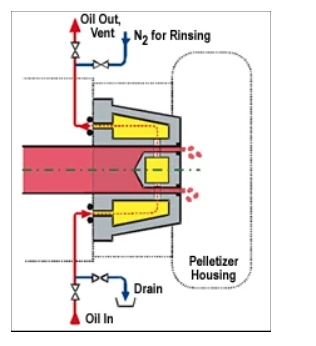
Compared to cylindrical heaters, oil heating can apply more uniform heat over a larger area. The oil system is configured with up to eight mold zones. But oil heating is more expensive than cylindrical heaters. Oil heating is commonly used in high output production lines of resin manufacturers or large blending plants. Recently, it has been applied on smaller systems to achieve better temperature control.
If the oil valve is blocked, the mold holes in the affected area of the mold will become colder and may freeze, but the rest of the mold will be fine. At the beginning, the output may not change. Similarly, like cylindrical heaters, the problem will manifest as defective particles.
All chips have some type of insulation layer. Most molds use special plates attached in the middle of the mold surface. But the plate may loosen. Then the water flows behind them, cooling the molds and potentially causing freezing.
Another insulation method is to use a "hollow" mold design with gaps containing vacuum. If it is not part of the original template design, it can be retrofitted onto most systems. Vacuum is a good insulator and cannot be damaged like solid insulation boards.
Reduce process fluctuations
Any type of extrusion process interruption or output fluctuation may cause freezing. For example, extruding recycled materials with low packing density can cause fluctuations in the output of the extruder, leading to inconsistent polymer flow and freezing of the mold holes in a random manner. Polymer melt pumps can be used to prevent these fluctuations and provide consistent die flow.
The use of discontinuous skateboard type screen changers can also cause flow interruption and trap air, resulting in temporary loss of polymer flowing towards the mold holes. May cause random freezing of mold holes. The solution is to use a continuous screen changer, which can instantly replace dirty screens without interrupting the process or trapping air.